


If You Work Nights, Your Body Is Leaving You a One-Star Review

Racing thoughts when you finally get to bed. Waking up after 4 hours and staring at the ceiling. Dragging through your shift on coffee and willpower, only to crash hard when you get home — and still not sleep properly.
If this sounds familiar, you're not imagining it. And you're definitely not alone.
"Whatever it looks like for you — I know how exhausting and demoralizing it gets," says Dr. [Sleep Specialist Name], a circadian health researcher who has spent years studying the effects of shift work on sleep biology.
Studies show that more than 40% of night shift workers report chronic, unrestorative sleep — meaning even when they do sleep, they wake up feeling like they didn't.
Most shift workers try everything: blackout curtains, melatonin, sleep masks, even prescription sleep aids. Yet for the vast majority, nothing really sticks. The sleep problems come right back.
Here's why: they're solving the wrong problem.
It's Not Your Discipline. It's Your Circadian Rhythm.
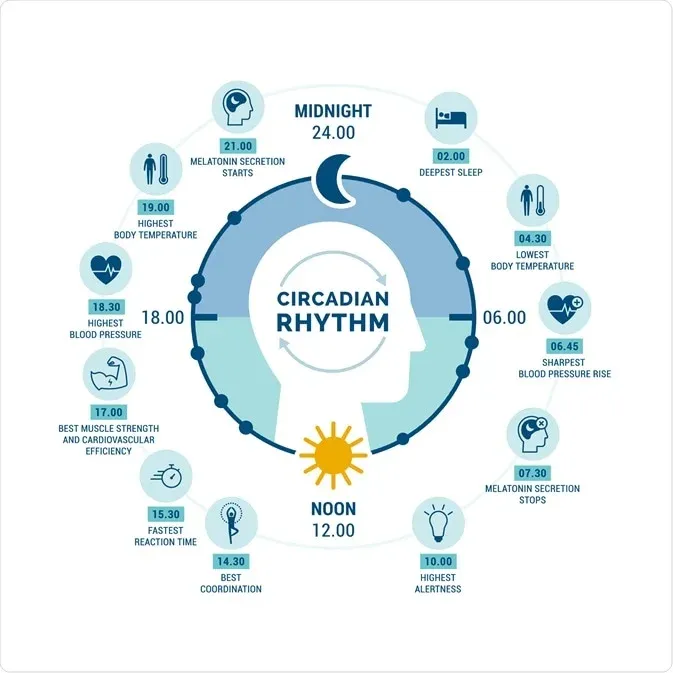
Researchers from Harvard Medical School and the National Sleep Foundation have identified what happens inside the body when you work against your natural sleep-wake cycle — and the results are striking.
Your body runs on something called a circadian clock — a 24-hour internal timer that tells every cell in your body when to be awake, when to wind down, and when to repair itself.
When you work nights, you're not just staying up late. You're asking your body to be alert during the exact window it was biologically programmed to sleep. And no amount of willpower changes the underlying biology.
What's worse: every time you flip back to a daytime schedule on your days off — something almost every shift worker does — you reset your clock back to square one. Your body never gets a chance to adapt.
"This is why I'm determined to teach shift workers how to support their circadian biology — not fight it," says Dr. [Name]. "The goal isn't to sleep harder. It's to stop working against your own nervous system."
But here's the catch: if you try to support your sleep with the wrong ingredients at the wrong time, you can actually make the dysregulation worse and set your recovery back by days.
Why Melatonin Is the Wrong Tool for Shift Workers

Most standard sleep advice was designed for people with a normal 9-to-5 schedule. But after years of night shifts, your body doesn't play by the same rules.
Shift workers have measurably lower baseline melatonin sensitivity than the general population — meaning the hormone supplements that help regular sleepers can overshoot, leaving you groggy, disoriented, and dependent on higher and higher doses to feel any effect.
- High-dose melatonin suppresses your body's natural production over time.
- Sedating antihistamines (like in most OTC sleep aids) leave a chemical hangover that makes your next shift harder.
- Extreme sleep hygiene routines add stress, which spikes cortisol — the exact opposite of what you need.
That's why so many shift workers feel stuck: doing everything "right" and still waking up exhausted.
The fix isn't more melatonin. It's a different mechanism entirely.
The Non-Hormonal Sleep Switch

Science points to a specific set of natural compounds that support sleep quality without involving the hormonal system at all — meaning no dependency, no crashes, and no interference with your body's own melatonin production.
You've probably heard of some of them. But when they're combined incorrectly — wrong ratios, wrong timing, wrong form — they do very little.
The key is a precise, synergistic formula that targets the nervous system's ability to wind down — not the hormonal system. When done right:
- Your nervous system transitions out of alert mode faster
- Your sleep becomes deeper and more restorative in fewer hours
- You wake up without the heavy, foggy feeling of sedatives
It's not magic. It's targeted nervous system support — something that works with shift work biology, not against it.
A Clinical-Grade Formula Built for This
That's exactly what was designed.
Unlike standard sleep remedies that dump in melatonin and call it a day, A clinically-dosed blend of five non-hormonal compounds was used. All of which are shown to support nervous system wind-down and sleep quality:
| Ingredient | Dose | Role |
|---|---|---|
| Magnesium Glycinate | 125 mg | Calms the nervous system, reduces muscle tension |
| L-Theanine | 100 mg | Quiets racing thoughts without sedation |
| 5-HTP | 100 mg | Supports serotonin balance and sleep cycle regulation |
| Valerian Root | 200 mg | Promotes relaxation without morning grogginess |
| Chamomile Extract | 75 mg | Gentle calming effect, anti-inflammatory |
No melatonin. No crash. No dependency.
Administered 30–60 minutes before your sleep window — whatever time that is.
What Shift Workers Are Saying
"I've been on nights for 11 years. I've tried everything. This is the first thing that's actually made a difference — I'm getting real sleep, not just lying in bed with my eyes closed."
— Marcus T., ICU Nurse
"I was skeptical of anything without melatonin, but I woke up after 6 hours actually feeling rested. That hasn't happened in two years."
— Denise R., Warehouse Supervisor
"My partner finally stopped complaining that I look dead. High praise."
— Yusuf A., Security Officer
Results like these aren't about sleeping more. They're about finally sleeping right — no matter when your window is.
Your Body Has Been Asking You to Do Something About This
You picked night shift for a reason. The pay, the schedule, the pace. You're not quitting.
But you don't have to keep running on empty either.
Sources:
- Harvard Medical School — Circadian Rhythm Disruption and Shift Work
- National Sleep Foundation — Shift Work & Sleep Disorder
- NIH — L-Theanine and sleep quality in adults
- Magnesium Glycinate and sleep: a randomized controlled trial (Journal of Sleep Research)
- Valerian root efficacy in sleep onset: systematic review (Phytomedicine)
